Wide Open. Gear

The Best Budget Cameras

Real interchangeable-lens cameras that punch above their price — and an honest note on where the money is genuinely worth spending.

By Stephen V.Last updated How we pick

“Budget” doesn’t mean “bad.” The cameras here all have real sensors far larger than any phone, shoot 4K, and take interchangeable lenses — the things that actually matter. What you give up at this price is usually in-body stabilization, a second card slot, weather sealing, or the newest autofocus. For a lot of people, none of that is a dealbreaker.

The trick with budget cameras is knowing which corners were cut and whether they matter to you. A cheaper camera with cropped, slower 4K is fine if you mostly shoot photos and daytime clips; it’s frustrating if you vlog in low light. We flag exactly what each one trades away, and we’re honest about the one or two places where spending a little more genuinely pays off.

How this is funded:we earn a commission if you buy through our links, at no extra cost to you. It never changes which product we recommend, and we’ll tell you plainly when to skip one. Full disclosure.

Quick picks

Ranked on published specs and buyer fit. Select a row to jump to the full write-up. We have not tested these products — here is exactly what we do instead.

#ProductBest forPrice
1
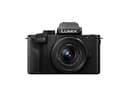
Panasonic LUMIX G100

Panasonic LUMIX G100

The budget vlogging camera with the cleverest party trick: built-in directional audio that follows your face, so you can often skip an external mic entirely. The Micro Four Thirds sensor is smaller than APS-C, but for well-lit talking-to-camera it is a tidy, complete little package.

Best value overall
2
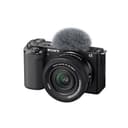
Sony ZV-E10

Sony ZV-E10

The interchangeable-lens vlogging camera most people should actually buy: a big APS-C sensor, a fully articulating screen, and Sony's E-mount so you can grow into better glass later. It skips a viewfinder and IBIS to hit its price, which is the right trade for a creator shooting off the screen.

Best for video
$898.00 · View on Amazon

Price as of July 28, 2026. #ad How we’re funded

3
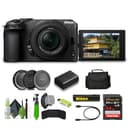
Nikon Z30

Nikon Z30

Nikon's vlogging-first crop body: no viewfinder, a fully articulating screen, and a comfortable grip that punches above its weight. A strong value if you are already in Nikon glass or want a content camera that still handles like a real camera in the hand.

Best handling
4
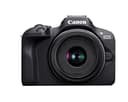
Canon EOS R100

Canon EOS R100

The cheapest way into Canon's mirrorless system, and honest about what it is: a stills-first starter camera. The 4K is cropped and uses slower contrast autofocus, and the screen is fixed — but for daytime photos and the occasional clip on a tight budget, it delivers a real APS-C sensor and RF mount.

Cheapest into a system
5
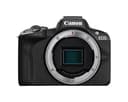
Canon EOS R50

Canon EOS R50

The friendliest beginner mirrorless camera going: Canon's excellent Dual Pixel autofocus, a genuinely helpful guided interface, and oversampled 4K30 in a body small enough to carry everywhere. It leans consumer — small grip, one slot — but it nails the thing beginners actually struggle with, which is focus.

Best all-rounder

The picks in full

#1Best value overall

Panasonic LUMIX G100

The budget vlogging camera with the cleverest party trick: built-in directional audio that follows your face, so you can often skip an external mic entirely. The Micro Four Thirds sensor is smaller than APS-C, but for well-lit talking-to-camera it is a tidy, complete little package.

Strengths

  • Built-in directional audio that tracks your face
  • Fully articulating screen and a small, light body
  • Includes a viewfinder — rare at this price

Trade-offs

  • Smaller Micro Four Thirds sensor struggles more in low light
  • 4K is cropped and time-limited; no in-body stabilization for video
SensorMicro Four Thirds CMOS, 20.3 MP
MountMicro Four Thirds
Video4K30 (cropped, time-limited)
AudioBuilt-in OZO Audio directional mic
Weight352 g with battery

Specifications read from the manufacturer listing, on July 18, 2026.

#2Best for video

Sony ZV-E10

The interchangeable-lens vlogging camera most people should actually buy: a big APS-C sensor, a fully articulating screen, and Sony's E-mount so you can grow into better glass later. It skips a viewfinder and IBIS to hit its price, which is the right trade for a creator shooting off the screen.

Strengths

  • APS-C sensor is a real low-light step up from any 1-inch compact
  • Fully articulating screen and creator-focused buttons
  • E-mount opens the door to the fast primes in our lens guides

Trade-offs

  • No viewfinder and no in-body stabilization
  • Rolling shutter shows up on fast pans
SensorAPS-C CMOS, 24.2 MP
MountSony E
Video4K30 (with crop), FHD up to 120p
StabilizationDigital only, no IBIS
Weight343 g with battery

Specifications read from the manufacturer listing, on July 18, 2026.

#3Best handling

Nikon Z30

Nikon's vlogging-first crop body: no viewfinder, a fully articulating screen, and a comfortable grip that punches above its weight. A strong value if you are already in Nikon glass or want a content camera that still handles like a real camera in the hand.

Strengths

  • Deep, comfortable grip unusual at this size
  • Fully articulating screen and a dedicated video record button
  • Good 20.9 MP sensor for stills and 4K

Trade-offs

  • No viewfinder and no in-body stabilization
  • 4K30 only; Z DX lens lineup is still small
SensorAPS-C (DX) CMOS, 20.9 MP
MountNikon Z
Video4K30, FHD120
ViewfinderNone (rear screen only)
Weight405 g with battery

Specifications read from the manufacturer listing, on July 18, 2026.

#4Cheapest into a system

Canon EOS R100

The cheapest way into Canon's mirrorless system, and honest about what it is: a stills-first starter camera. The 4K is cropped and uses slower contrast autofocus, and the screen is fixed — but for daytime photos and the occasional clip on a tight budget, it delivers a real APS-C sensor and RF mount.

Strengths

  • Lowest entry price into Canon RF
  • Light and genuinely pocketable with the kit lens
  • Fine 1080p and good daytime stills

Trade-offs

  • 4K is heavily cropped with slower contrast-detect AF
  • Fixed, non-touch screen limits vlogging
SensorAPS-C CMOS, 24.1 MP
MountCanon RF
Video4K30 (cropped), FHD60
ScreenFixed, non-touch
Weight356 g with battery

Specifications read from the manufacturer listing, on July 18, 2026.

#5Best all-rounder

Canon EOS R50

The friendliest beginner mirrorless camera going: Canon's excellent Dual Pixel autofocus, a genuinely helpful guided interface, and oversampled 4K30 in a body small enough to carry everywhere. It leans consumer — small grip, one slot — but it nails the thing beginners actually struggle with, which is focus.

Strengths

  • Dual Pixel autofocus is the easiest to trust at this price
  • Guided menu genuinely teaches as you shoot
  • Oversampled, uncropped 4K30

Trade-offs

  • Small grip and body feel toy-like with bigger lenses
  • No in-body stabilization; RF-S lens choice is still thin
SensorAPS-C CMOS, 24.2 MP
MountCanon RF
Video4K30 (oversampled, uncropped)
AutofocusDual Pixel CMOS AF II
Weight375 g with battery

Specifications read from the manufacturer listing, on July 18, 2026.

Where to spend and where to save

Save on the body; don’t save on the card or the lens. A slow, cheap memory card can bottleneck 4K — see our SD card guide for the right (still-affordable) choice. And one fast prime lens from our lens guides will improve your photos more than spending the same money on a pricier body.

If your budget is genuinely tight, remember that a good camera you own beats a great one you can’t afford. Buy the one that fits the budget, learn it, and upgrade only when you hit a real limit — not a spec-sheet one.

Frequently asked questions

What's the cheapest camera worth buying?

The Canon R100 is the lowest-cost way into a modern interchangeable-lens system, and it's genuinely fine for daytime photos and casual clips. Just know its 4K is cropped and uses slower autofocus — if video matters, stretch to the Panasonic G100 or Sony ZV-E10.

Should I buy a used camera to save money?

It can be smart, especially for an older but capable body like a used mirrorless camera or even a DSLR. Buy from a reputable seller with a return policy, check the shutter count where relevant, and make sure lenses are still available for the mount.

Is a budget camera better than a flagship phone?

For image quality in low light, background blur and the ability to change lenses, yes — a real camera pulls ahead. For sheer convenience and computational tricks, a modern phone is remarkable. Many creators use both.

What do I lose by going budget?

Usually in-body stabilization, weather sealing, a second card slot, and the latest autofocus. Whether those matter depends on how you shoot — we flag each trade-off on the picks above.

Do budget cameras shoot good enough video for YouTube?

Yes. Every camera here shoots 4K suitable for YouTube. Pair it with a decent microphone and some light and it will look far more professional than the price suggests.

Sources

Keep reading