Wide Open. Gear

The Best USB Microphones

Plug-and-play mics for voiceover, podcasting and streaming from a desk — and why a dynamic mic beats a condenser in a noisy room.

By Stephen V.Last updated How we pick

A USB microphone is the simplest way to get great sound at a desk: plug it into your computer, and you’re recording studio-quality audio with no interface, no drivers, no fuss. It’s the right tool for voiceover, podcasting, streaming and video calls — anything where you sit still and talk.

The single most important decision is condenser versus dynamic. Condensers(like the RODE NT-USB+ and Blue Yeti) are sensitive and detailed — brilliant in a quiet, treated room, but they also hear your keyboard, the fan and the street. Dynamic mics (like the Shure MV7) hear far less of the room, so they forgive an untreated home office. If your space echoes or has background noise, a dynamic mic will treat you better. We’ve picked the best of both below.

How this is funded:we earn a commission if you buy through our links, at no extra cost to you. It never changes which product we recommend, and we’ll tell you plainly when to skip one. Full disclosure.

Quick picks

Ranked on published specs and buyer fit. Select a row to jump to the full write-up. We have not tested these products — here is exactly what we do instead.

#ProductBest forPrice
1
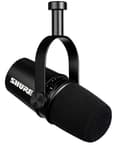
Shure MV7

Shure MV7

The mic that fixes bad rooms. A dynamic mic modeled on the legendary SM7B, it rejects room echo and background noise the way condensers can't, so it forgives an untreated home office. USB and XLR outputs mean it grows with you. For podcasting and voice in a real-world room, it is the smart pick.

Best overall
$299.00 · View on Amazon

Price as of July 28, 2026. #ad How we’re funded

2
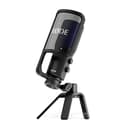
RODE NT-USB+

RODE NT-USB+

A studio-grade USB condenser that skips the complexity. Plug it into a computer, hear yourself through the built-in headphone jack with zero latency, and record clean, detailed voice with no interface to buy. Condensers pick up room sound, so it wants a quiet, treated space — get that right and it sounds superb.

Best for voiceover
$157.00 · View on Amazon

$179.0012% off

Price as of July 28, 2026. #ad How we’re funded

3
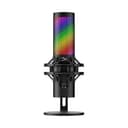
HyperX QuadCast 2 S

HyperX QuadCast 2 S

The streamer's USB condenser, with the RGB to match. A tap-to-mute top, a built-in shock mount and pop filter, and four pickup patterns make it a genuinely convenient all-in-one. It is a condenser, so it likes a quieter room — but for a gaming desk it is one of the tidiest packages going.

Best for streaming
$116.26 · View on Amazon

$199.9942% off

Price as of July 28, 2026. #ad How we’re funded

4
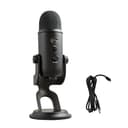
Blue Yeti USB Microphone

Blue Yeti USB Microphone

The USB mic everyone knows, and still a fair pick for its price and its four pickup patterns. The catch is that it is a sensitive condenser that hears everything — keyboard, room, the street. In a quiet space it sounds great; in a noisy one, a dynamic mic like the Shure MV7 will treat you better.

Best value
$109.99 · View on Amazon

$139.9921% off

Price as of July 28, 2026. #ad How we’re funded

5
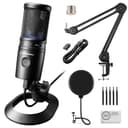
Audio-Technica AT2020USB-X

Audio-Technica AT2020USB-X

The quiet, no-nonsense USB condenser for people who just want clean sound. The AT2020 is a studio staple, and the USB-X version adds a headphone jack, on-mic mute and mix control without the hype or the RGB. It sounds excellent in a treated room and gets out of your way.

Best no-frills
$185.90 · View on Amazon

Price as of July 28, 2026. #ad How we’re funded

The picks in full

#1Best overall

Shure MV7

The mic that fixes bad rooms. A dynamic mic modeled on the legendary SM7B, it rejects room echo and background noise the way condensers can't, so it forgives an untreated home office. USB and XLR outputs mean it grows with you. For podcasting and voice in a real-world room, it is the smart pick.

Strengths

  • Dynamic capsule rejects room echo and background noise
  • Both USB and XLR — start simple, upgrade later
  • Built-in headphone monitoring

Trade-offs

  • Wants close, on-axis placement to sound its best
  • Costs more than most USB condensers
TypeDynamic (USB + XLR)
PatternCardioid
MonitoringBuilt-in headphone output
ConnectionUSB and XLR

Specifications read from the manufacturer listing, on July 18, 2026.

#2Best for voiceover

RODE NT-USB+

A studio-grade USB condenser that skips the complexity. Plug it into a computer, hear yourself through the built-in headphone jack with zero latency, and record clean, detailed voice with no interface to buy. Condensers pick up room sound, so it wants a quiet, treated space — get that right and it sounds superb.

Strengths

  • Studio-quality detail from a plug-and-play USB mic
  • Built-in headphone jack for zero-latency monitoring
  • On-mic controls and included pop filter

Trade-offs

  • Condenser — reveals room echo and background noise
  • Needs a stand or boom arm for best placement
TypeUSB condenser
PatternCardioid
MonitoringBuilt-in headphone output
ConnectionUSB-C

Specifications read from the manufacturer listing, on July 18, 2026.

#3Best for streaming

HyperX QuadCast 2 S

The streamer's USB condenser, with the RGB to match. A tap-to-mute top, a built-in shock mount and pop filter, and four pickup patterns make it a genuinely convenient all-in-one. It is a condenser, so it likes a quieter room — but for a gaming desk it is one of the tidiest packages going.

Strengths

  • Built-in shock mount and pop filter — nothing extra to buy
  • Tap-to-mute top and four pickup patterns
  • USB-C with headphone monitoring

Trade-offs

  • Condenser sensitivity picks up a noisy room
  • RGB is not to everyone's taste
TypeUSB condenser
PatternsCardioid, omni, bidirectional, stereo
FeaturesTap-to-mute, built-in shock mount
ConnectionUSB-C

Specifications read from the manufacturer listing, on July 18, 2026.

#4Best value

Blue Yeti USB Microphone

The USB mic everyone knows, and still a fair pick for its price and its four pickup patterns. The catch is that it is a sensitive condenser that hears everything — keyboard, room, the street. In a quiet space it sounds great; in a noisy one, a dynamic mic like the Shure MV7 will treat you better.

Strengths

  • Four pickup patterns for solo, duet or room recording
  • Plug-and-play with on-mic gain, mute and monitoring
  • Widely supported and often discounted

Trade-offs

  • Sensitive condenser picks up room and keyboard noise
  • Large and heavy on its included stand
TypeUSB condenser
PatternsCardioid, omni, bidirectional, stereo
MonitoringBuilt-in headphone output
ConnectionUSB

Specifications read from the manufacturer listing, on July 18, 2026.

#5Best no-frills

Audio-Technica AT2020USB-X

The quiet, no-nonsense USB condenser for people who just want clean sound. The AT2020 is a studio staple, and the USB-X version adds a headphone jack, on-mic mute and mix control without the hype or the RGB. It sounds excellent in a treated room and gets out of your way.

Strengths

  • Trusted studio capsule with a clean, natural sound
  • Headphone jack, mute and monitor mix on the mic
  • Understated design — no lights, no gimmicks

Trade-offs

  • Condenser needs a quiet, treated space
  • No stand upgrade in the box; wants a boom arm
TypeUSB condenser
PatternCardioid
MonitoringHeadphone output with mix control
ConnectionUSB-C

Specifications read from the manufacturer listing, on July 18, 2026.

Getting the most from a USB mic

Placement beats price. Get the mic within a hand’s width of your mouth and slightly off-axis to avoid plosives, and use the built-in headphone jack (most of these have one) to monitor yourself with zero latency. A boom arm keeps the mic close and your desk clear — a worthwhile add-on for any of these.

If your room is echoey and you can’t treat it, choose the dynamic Shure MV7 — it hears far less of the space. If you have a quiet, soft room, a condenser like the NT-USB+ gives you more detail. Either way, pair it with decent lighting for a complete desk setup, and see our webcam guide to finish the picture.

Frequently asked questions

Condenser or dynamic USB mic — which should I buy?

If your room is quiet and soft, a condenser (like the RODE NT-USB+) gives more detail. If your room echoes or has background noise — a typical home office — a dynamic mic (like the Shure MV7) hears far less of it and sounds cleaner. Room quality decides this more than price.

Why does the Blue Yeti pick up so much background noise?

The Yeti is a sensitive condenser, and by default many people use its omnidirectional or wide patterns, which hear the whole room. Switch it to the cardioid (front-only) pattern, get closer, and turn the gain down. Even then, a dynamic mic is better in a noisy space.

Do I need an audio interface with a USB mic?

No — that's the whole point of a USB mic. It has the interface built in and plugs straight into your computer. If you later want an XLR mic or multiple mics, that's when an interface comes in; several picks here (like the MV7) offer XLR for that upgrade path.

Is a USB mic good enough for a professional podcast?

Yes. Modern USB dynamic mics like the Shure MV7 are used on plenty of professional podcasts. The mic is rarely the limiting factor — your room and your placement matter more.

Can I monitor my voice while recording?

Yes, if the mic has a built-in headphone jack — most of these do. Plug headphones directly into the mic to hear yourself with zero latency, which helps you catch problems as you record.

Sources

Keep reading