How to choose a Fujifilm camera
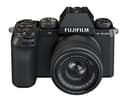
Start with whether you shoot video as well as stills. The X-S20is the creator’s pick because it adds the two things video shooters miss on the cheaper bodies: in-body stabilization for handheld footage, and a fully articulating screen that flips forward. It also has standout battery life and a dedicated Vlog mode. If you film regularly, it’s the one to buy, and it leads our hybrid camera guide for exactly that reason.
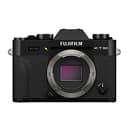
If you’re a stills-first photographer on a budget, the X-T30 IIgives you the same 26-megapixel sensor and film-simulation color in a smaller, cheaper, dial-driven body. The trade is that its screen tilts but doesn’t face forward for vlogging, and there’s no in-body stabilization. For someone who mainly shoots photos and loves physical controls, it’s the sweet spot — we compare it directly with Sony’s benchmark in our X-T30 II vs a6400 piece.
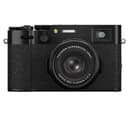
The X100VIis a different kind of camera entirely: a fixed 35mm-equivalent lens, a gorgeous hybrid optical/electronic viewfinder, in-body stabilization and a 40-megapixel sensor in a pocketable body. It’s a deliberate, one-focal-length tool that street and everyday shooters adore — but it’s not a do-everything camera, and it’s chronically hard to find at list price. Buy it because you want to travel light and shoot one lens well, not because you want flexibility.
The Fujifilm lens question
Two of these three take interchangeable X-mount lenses (the X100VI is fixed), and the mount is a real strength: Fujifilm makes a deep line of compact, high-quality primes and zooms, and there’s good third-party support. The kit zoom is fine to start, but the fastest way to unlock that Fujifilm look is a bright prime that blurs the background and gathers light — the same principles we cover in our portrait lens guide and lens buying guide apply directly. And as with any camera, a good microphone will do more for your video than a sensor upgrade ever could. Still deciding between systems entirely? Start with what camera should I buy.